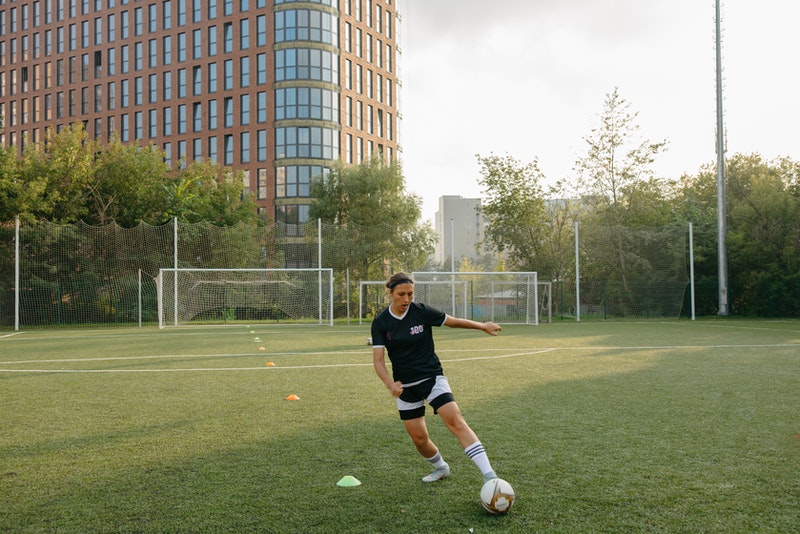
Small-sided games are one of the most useful tools a coach has: more touches, more decisions and more goals than a full scrimmage. They come with one common problem, though. As soon as a goal is in play, one player on each team tends to camp in front of it and "guard" the net. That player gets few touches, the game loses a body in attack, and nobody learns much. Rotating Goalie fixes the problem with one simple rule: the goalkeeper is whoever happens to be closest to the goal.
Set-Up
- Players: any number per team. Four against four works very well.
- Field: for two teams of four, roughly 30 to 35 yards long and 20 to 25 yards wide. Scale it up or down for bigger or smaller groups.
- Goals: small goals or pop-up nets at each end, or two cones about four yards apart.
- Bibs: two colors so players can tell teams apart quickly.
Rules
- Play a normal game with no offside.
- When the ball goes out, restart by dribbling it in or passing it in. The coach can also allow throw-ins, or simply serve a new ball to keep the game moving.
- For each team, the player nearest their own goal at any moment may use their hands as the goalkeeper. As play moves, that role changes from player to player.
- A goalie who catches the ball must release it straight away, either by throwing it to a teammate or by putting it down and dribbling. No holding on to it while everyone resets.
Because anyone can end up in goal, nobody can hide there, and every player gets a turn at handling, positioning and starting the next attack.
Why It Works
Everyone stays involved. Players can't plant themselves on the goal line, so all of them join the build-up and the defending.
It teaches team defending. After losing possession, the player nearest their own goal has to drop back quickly to cover. That is the start of good defensive organization, the same idea behind the principle of cover in our guide to the principles of play.
It introduces goalkeeping to everyone. Field players learn what it feels like to save a shot and distribute quickly, which helps when they need to cover for an injured keeper or simply understand what their keeper needs from them.
Quick transitions. The immediate release rule keeps the ball moving, so teams practice switching from defending to attacking in a split second. Our page on transition game practice builds on the same habit.
Coaching Points
- Ask players to keep looking over their shoulders so they know who is nearest their own goal.
- Encourage the temporary goalie to talk: "I'm in," "cover me" or "drop."
- Praise quick, accurate releases from the goalie more than spectacular saves.
- Remind attackers to shoot early, before the defending team has someone settled in goal.
Variations
Timed keepers: instead of the nearest player, give each player a turn in goal for a set period, such as 90 seconds, then rotate.
Feet only goalies: for younger groups, the nearest player may block with their body but not use their hands. It removes any worry about catching hard shots.
Bonus goals: a goal scored within five seconds of a goalie's throw counts double, which rewards fast counterattacks.
Three teams: rotate a third team in after each goal, as in our 3v3v3 game, so resting players watch and learn.
A Sample 20 Minute Block
- 5 minutes: passing in pairs inside the playing area to warm up, with the coach explaining the nearest player rule.
- 3 rounds of 4 minutes: the game itself, with a one minute break between rounds for water and one coaching point each time.
- Final 3 minutes: add the bonus goal rule so teams look to counter quickly after every save.
Common Problems and Quick Fixes
Arguments over who was nearest. The coach's call stands. Keep it light; the point is to play, not debate.
A player who loiters near goal to stay keeper. Add a rule that the temporary keeper must leave the area as soon as they release the ball.
Nobody wants to go in goal. Count saves as points for the team, so a good stop is worth as much as a goal.
Age and Safety Notes
Use soft balls or reduce shooting power with young players who are not used to catching. Keep goals small so the temporary keeper is never facing hard shots from close range at a full-size net. With older teams, the game works as a lively warm-up before a full scrimmage, and it often reveals which players have a natural feel for the position. When a player shows that feel, our keeper training guide is a good place to start coaching them in the role.
For more ways to keep practices active and competitive, see our soccer practice games collection.