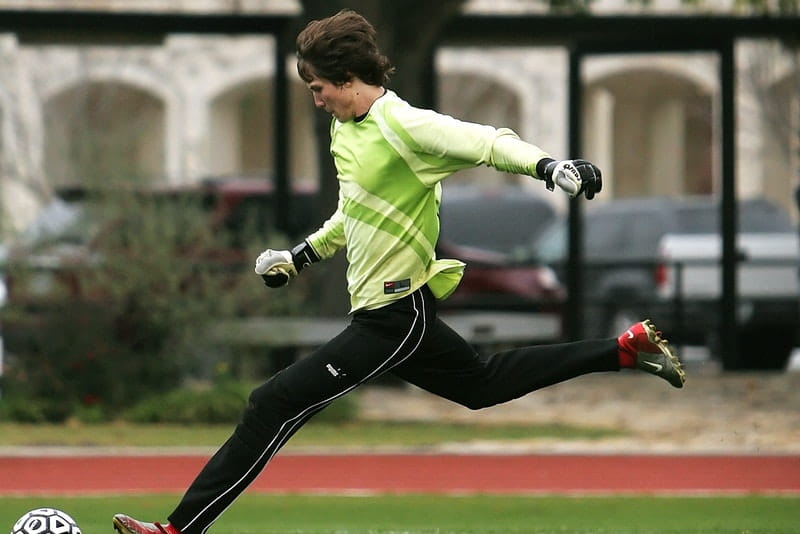
A good punt turns a save into an attack. When a goalkeeper catches the ball and sends it 50 yards upfield, the team gets out of trouble, the defense gets time to reset, and a quick forward might even find space behind the other back line. A poor punt does the opposite: it slices out of bounds or drops straight to an opponent, and the pressure comes right back. The good news is that punting is a skill any keeper can improve with simple, regular practice.
When a Punt Is the Right Choice
Keepers have several ways to restart play once they hold the ball: rolling it, throwing it, passing it along the ground after putting it down, a drop kick or a punt. Each one fits a different moment.
- Roll or throw when a defender or midfielder is open nearby. These are the most accurate options and keep possession most often.
- Drop kick (the ball is struck just as it bounces) when you want distance with a flatter, faster flight. It needs a firm, even surface.
- Punt (the ball is struck before it touches the ground) when the team needs height and distance, or the field is too wet or bumpy for a reliable drop kick.
Because a high punt usually comes down among several players, it often creates a contested ball rather than a clean pass. Teams that punt a lot should practice what happens next, from heading duels to collecting the second ball. That part of the game is covered in our page on winning 50/50 balls.
The Rules You Need to Know
Under Law 12 of the Laws of the Game, a goalkeeper may hold the ball in their hands for eight seconds. The referee shows the last five seconds with a raised hand, and a keeper who holds on longer gives the other team a corner kick. Some youth and school competitions play their own version of this rule, so ask your league which one applies. Keepers can only handle the ball inside their own penalty area, so the whole punting motion, from catch to release, needs to start well inside the box. If you take several steps to wind up, begin them far enough back that your hands never carry the ball over the line. Our page on soccer rules explained covers the other handling rules.
Younger players may not be allowed to punt at all. Under U.S. Soccer's 7v7 standards for young age groups, a goalkeeper who punts or drop kicks gives the other team an indirect free kick, so keepers restart by throwing, rolling or passing instead. Check your league's rules before you build a session around punting.
How to Punt, Step by Step
- Hold the ball out in front. Carry it at about waist height in both hands, or in the hand opposite your kicking foot, with your arms slightly extended.
- Take a short approach. Two or three steps are enough. Your last step should be a firm plant with the non-kicking foot pointing at the target.
- Drop, don't toss. Release the ball straight down from your hands. Throwing it up or out to the side is the most common cause of a wild punt, because the ball is never in the same place twice.
- Strike with the laces. Point your toes down, lock your ankle and meet the middle of the ball with the top of your foot, the same surface used for a strong instep drive.
- Finish toward the target. Allow the kicking leg to swing up and through. Many keepers land on the kicking foot after the swing, which is a sign the weight went forward into the ball.
The height of contact shapes the flight. Meeting the ball close to knee height produces a lower, driving punt; meeting it higher sends it up into the air. Practice both, because a strong wind or a tall opposing midfield may call for a flatter ball.
Watch It Done
Seeing the motion at full speed helps. ARS Goalkeeping has a short demonstration of the technique:
https://www.youtube.com/watch?v=HANyK23Hquc
Watch it once at normal speed, then again slowly, paying attention to how the ball is released and where the plant foot lands.
Practice Drills
Target zones. Mark three wide channels across the far half of the field with cones. Call out a channel before each punt and score a point for every ball that lands in it. Ten punts per round, then swap with a partner who collects.
Release only. Without kicking, drop the ball from your hands onto a spot marked by a cone in front of your plant foot. Repeat until the ball lands on the cone almost every time. A consistent drop is half of a consistent punt.
Punt and pass. A teammate stands in the center circle. The keeper punts toward them, and the receiver must control the ball within two touches and pass it back along the ground. It trains accuracy and gives field players practice dealing with a dropping ball.
Eight second challenge. A coach serves a shot or cross. After the save, the keeper has eight seconds to get the ball away with an accurate punt, throw or roll, choosing the right option based on where teammates are standing.
Common Mistakes and Fixes
- The ball goes sideways: usually an uneven drop or an open hip at contact. Square your hips to the target and release with both hands.
- Too much height, little distance: the ball is being met too high or with the toe. Lock the ankle and strike lower.
- Weak contact: a slow approach or no follow through. Add a quicker final step and swing through the ball.
- Kicking with the wrong surface: striking with the toe hurts and sprays the ball. Point the toes down so the laces make contact.
- Rushing the decision: punting every time, even when a short throw is open. Look before you kick.
Building Range Over a Season
Distance comes from clean contact first and leg strength second. Keepers who chase power before technique tend to slice more often. Spend most early sessions on accuracy at moderate range, then stretch the target zones as contact improves. General leg strength and hip mobility help too; see our notes on core strength in soccer. A few minutes of punting at the end of every training session adds up quickly over a season. To see where punting sits among the other skills a keeper trains each week, read our complete guide to goalkeeper training.