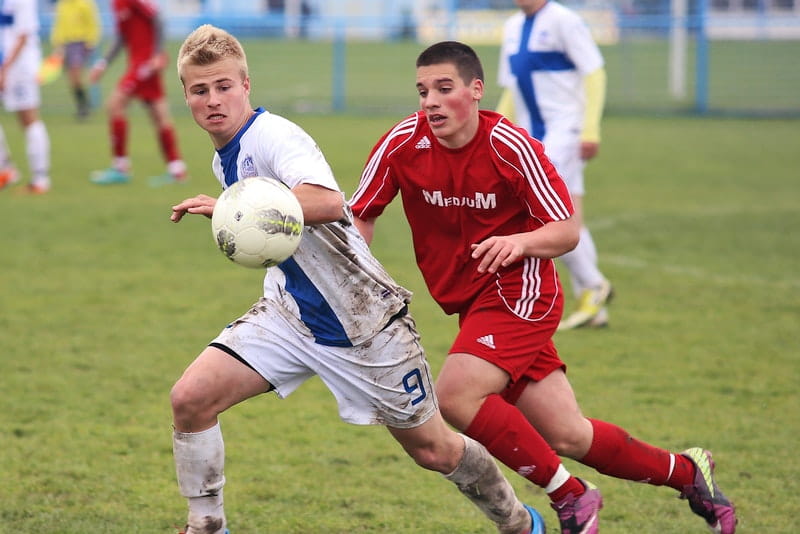
My coach is always telling us to jockey and not stab at the ball. What does he mean?
Your coach is describing two different ways of defending against a player with the ball. One is patient and controlled. The other is a gamble that often fails. Here's what each means and how to jockey well.
What Is Jockeying?
Simply put, jockeying (also called shepherding) means guiding the ball carrier, and the ball, where you want them to go. You stay between the attacker and your goal, close enough to pressure them but not so close that they can slip past. You don't try to win the ball right away. Instead, you delay the attacker, take away their options and wait for a mistake.
What Is Stabbing?
Stabbing at the ball is when you stick your leg or hip out to try to knock the ball away from the ball carrier. It can pay off, because you might win the ball. But it's a much higher risk. If you stab and miss, you're likely to be off balance and out of position, and the attacker can get past you, leaving your team exposed.
Why Coaches Prefer Jockeying
When you jockey, the attacker has to make the next move. Every second you delay them gives your teammates time to recover and get behind the ball. When you stab, you make the first move, and a good attacker will be waiting for exactly that.
How to Jockey
- Approach fast, arrive under control. Cover the ground quickly, then shorten your stride for the final few yards so you're balanced when you get there.
- Stay goal-side. Position yourself between the ball carrier and the goal.
- Turn your body. Open your stance at an angle, staggering your feet, with knees flexed and your weight forward.
- Show them one way. Angle your body to force the attacker toward the touchline (sideline), or onto their weaker foot.
- Keep your distance. About an arm's length is a good guide. Too far gives them time; too close lets them knock it past you.
- Watch the ball. Keep your focus on the ball, not the attacker's feet or body.
- Move with them. Shuffle and backpedal to stay in front. Don't cross your feet.
- Be patient. Your goal is to take away options. Keep the dribbler where you want them and wait for a mistake, or let them dribble themselves into a corner.
Footwork Matters
Good jockeying is mostly footwork. Take small, quick steps, keep your weight forward over your toes and never cross your legs, which leaves you unable to change direction. If the attacker accelerates past your side, use a drop step: pull your back foot behind you, open your hips and turn to run with them.
Use the Sideline as a Defender
The touchline is your friend. Once you've shown an attacker toward it, they have less space and fewer options. Keep your body angled so the inside route is closed, and let the line do half the work. Many attackers end up running the ball out of play or making a hurried pass.
Read the Attacker's Touch
Watch how the attacker controls the ball. A player who keeps it close is hard to tackle, so stay patient. A player whose touches get bigger as they speed up is offering you a chance. Time your tackle for the moment the ball leaves their foot.
When to Win the Ball
Jockeying doesn't mean never tackling. Step in when:
- The attacker takes a heavy touch and the ball moves away from their foot.
- They turn their back on you.
- A teammate arrives to support, so you can press harder.
- They're trapped near the sideline with nowhere to go.
When you do go in, commit fully with a firm block tackle and stay on your feet if possible.
Jockeying Drills
Channel drill: mark a channel 10 yards wide and 20 long. An attacker dribbles from one end, and a defender jockeys them toward one side, trying to make them run out of the channel.
Shadow defending: without a ball, a partner moves forward and changes direction while you jockey backward, staying an arm's length away.
One-on-one to a line: the attacker tries to dribble across the line behind the defender. The defender is only allowed to tackle after the attacker takes three touches, which forces patience.
Jockeying in Small-Sided Games
Small-sided games, such as 2 v 2 or 3 v 3 in a tight area, give defenders constant chances to jockey. Coaches can add a rule that a defender only scores a point for winning the ball after making the attacker change direction at least once. It rewards patience over stabbing.
Common Mistakes
- Arriving too fast and running past the attacker.
- Facing the attacker flat-on, which leaves both sides open.
- Crossing your feet while backpedaling.
- Diving in at the first chance, which is stabbing by another name.
- Watching the attacker's feet instead of the ball.
Jockeying as a Team
Jockeying works best when the rest of the team helps. While one defender jockeys, a second should cover at an angle behind them, ready to step in if the attacker gets past. Talk constantly: tell your teammate which way to show the attacker and let them know when you're in position to help.
Jockeying for Younger Players
Young players often charge at the ball, which is natural. Teach jockeying as a game: "Can you keep the dribbler away from the cone for ten seconds without touching the ball?" It builds patience and balance before they learn to tackle.
Know Your Role on the Field
Where you are on the field changes how you jockey. Near your own goal, stay goal-side and focus on preventing a shot. In midfield, you can show the attacker toward the touchline and wait for help. Near the opponent's goal, a forward jockeying a defender can be more aggressive, pressing to force a mistake or a long ball.
For more defending skills, see how to stop someone from shooting and our guide to practicing your defense.